Deep rest
A fully clothed session offers time to be still without needing to perform or explain.
DA’SHEA’S SIGNATURE PRACTICE
Reiki helped shape Da’Shea’s own path toward self-care and became the heart of Healing Heartstrings. Come curious, stay fully clothed, and experience a gentle session with no pressure to feel any one thing.
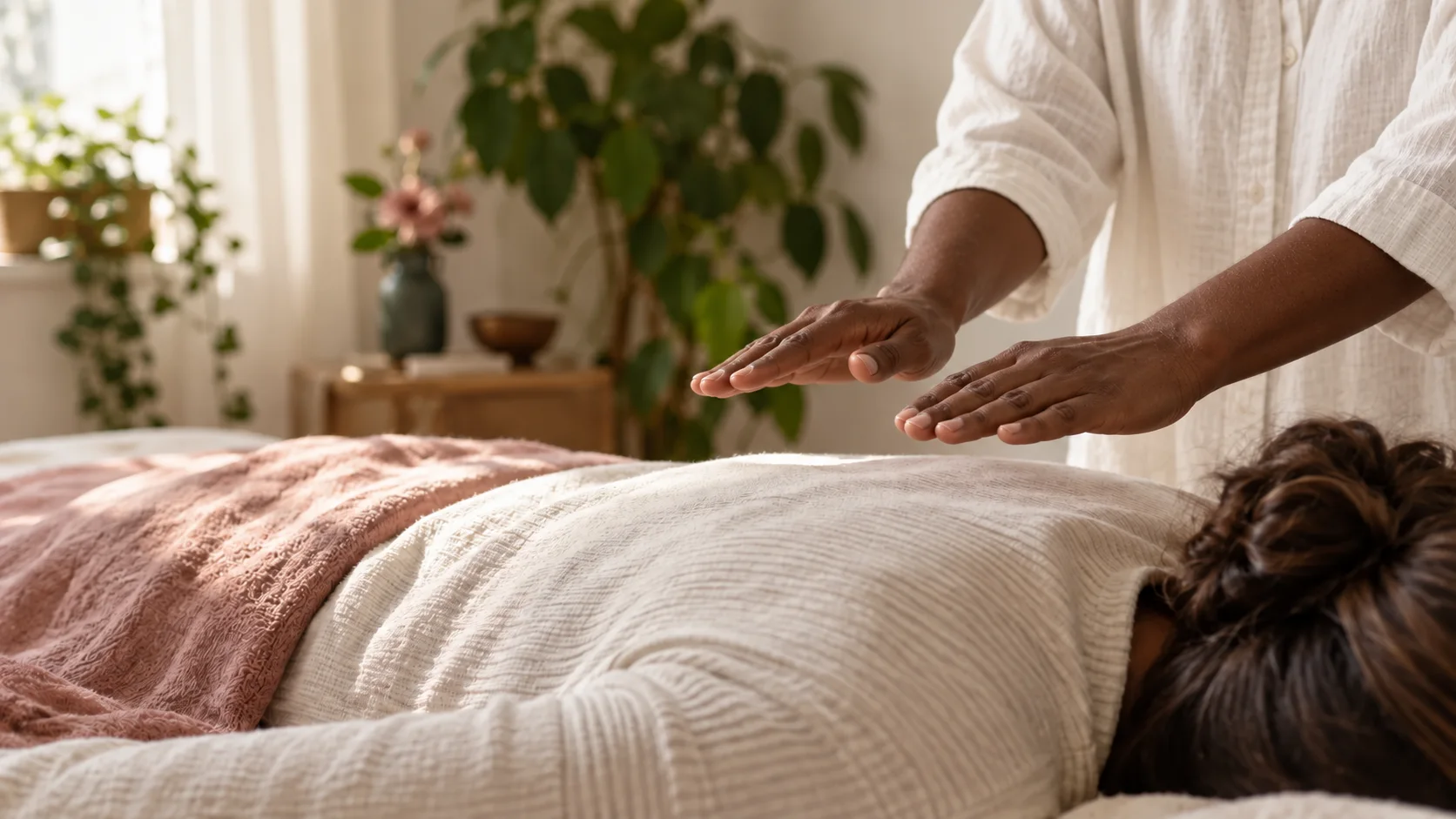 ILLUSTRATIVE REIKI EXPERIENCE
WHAT REIKI IS
Reiki is a complementary wellness practice developed in Japan in the early twentieth century. In a typical session, a practitioner places their hands lightly on—or holds them just above—a fully clothed person. There is no massage, pressure, or physical manipulation.
Within Reiki tradition, practitioners describe working with a universal life energy. Modern research has not established the proposed energy field or a specific biological mechanism. At Healing Heartstrings, the promise is the experience: quiet, attention, consent, and room to settle—not a guaranteed outcome.
Reiki is complementary care. It does not diagnose, treat, cure, or prevent a condition, and it should not replace medical or mental health care.
WHY PEOPLE MAKE ROOM FOR IT
People commonly describe Reiki as restful or calming. Some notice warmth, tingling, emotion, drowsiness, or a shift in attention. Others notice very little. Every response can be different.
A fully clothed session offers time to be still without needing to perform or explain.
Many clients seek Reiki as a quiet transition away from the noise and pace of the day.
You may notice breath, body sensations, thoughts, or emotions—or simply enjoy the silence.
The session can create intentional space to reconnect with what you need in that moment.
These are experiential possibilities, not promised health outcomes. Federal health guidance says Reiki has not been clearly shown effective for a health-related purpose, though it has not been shown to cause harmful effects.
YOUR FIRST SESSION
Da’Shea can confirm her exact format and accommodate reasonable comfort preferences before the session begins.
Start with a short conversation about comfort, touch preferences, and what brought you in.
Remain fully clothed and settle into a supported seated or reclined position.
With consent, hands may rest lightly on you or hover just above. There is no pressure or manipulation.
You might feel warmth, tingling, calm, emotion, sleepiness—or nothing distinct at all.
Take a moment to sit up, ask questions, and transition back into the rest of your day.
A SHORT HISTORY
Modern Usui Reiki is generally traced to Mikao Usui, who taught his system in Japan in the early 1920s. The practice developed through different teachers and lineages as it spread beyond Japan.
Some popular origin stories mix documented history with oral tradition. That is why this page keeps the history broad and separates traditional explanations from what scientific research can currently establish.
RESEARCH & PERSPECTIVE
This overview draws on federal health guidance, a clinical explainer, qualitative research into reported session experiences, and documented Reiki history. Research findings are mixed, and personal reports do not prove a medical effect.
3090 W. Market St., Suite 103
Fairlawn, OH 44333
Get directions ↗
Tuesday–Friday: 9am–2pm & 4pm–8pm
Saturday–Sunday: 9am–8pm
Visits by appointment.